

For the nights you decide you have no discipline.
Six Steps to Make Willpower Easier
Small changes to your environment that make following through easier
What it helps you do
- Find the hour your plans actually fall apart
- Make the right thing easier to start, and the wrong thing a little annoying
- Rewind a slip in seven questions and find the one lever
- Stop renegotiating the same choice every night
- Shrink a plan until it can’t be refused
- Name the feeling you’re really putting off
- Use other people on purpose, and know when not to
If the file won’t open or isn’t what this page describes, you get a new file or a full refund.
Look inside firstBefore you start
Two Thursdays
Same person, same deadline, one week apart.


That night she decides she has no discipline. She doesn’t mention the library.
One Thursday got the credit. The other got the blame. Neither got looked at.
From page 2 of the Guide
Use it when
- Four o’clock at the desk, and the morning’s plan is gone.
- Sunday, a big plan that feels great. Wednesday, a reason to skip.
- 11:20 p.m., phone in hand, card saved in the app.
- The night you decide, again, that you have no discipline.
Willpower is a word for afterward. It names the result, and skips the cause. People who follow through reliably mostly aren’t great resisters. They meet fewer temptations to begin with, because of how their days are arranged. The six steps are changes of that kind, made before the hard moment arrives.
Keep thisStop grading the person. Start reading the room.
Look inside
Real pages from the Guide, so you can judge it before you buy.
The six steps
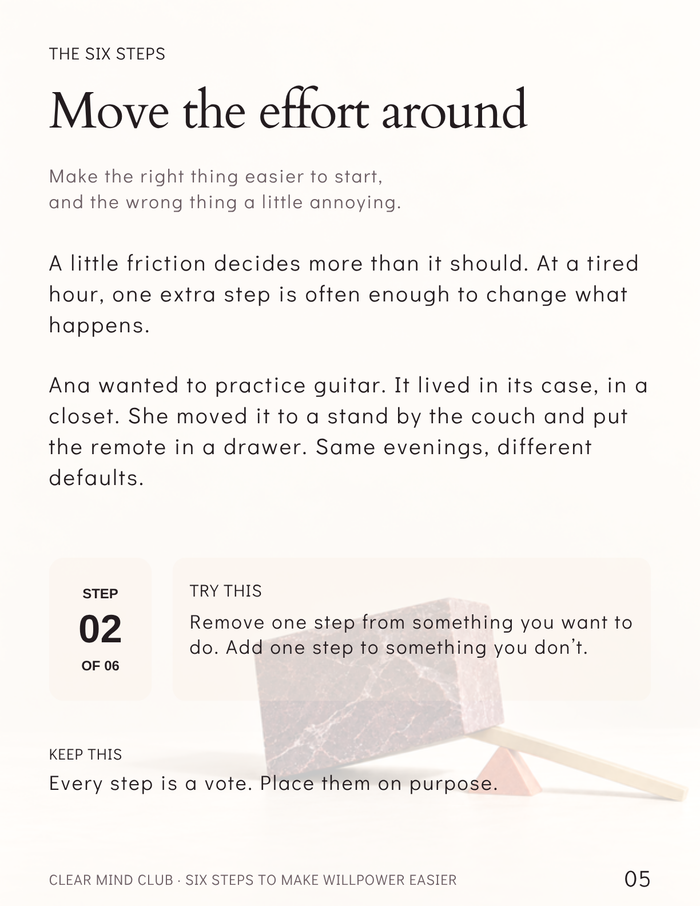
Move the effort around
Make the right thing easier to start, and the wrong thing a little annoying.
A little friction decides more than it should. At a tired hour, one extra step is often enough to change what happens.
Ana wanted to practice guitar. It lived in its case, in a closet. She moved it to a stand by the couch and put the remote in a drawer. Same evenings, different defaults.
Keep this
Every step is a vote. Place them on purpose.
Clear Mind Club · Six Steps to Make Willpower Easier5

The cover 
Two Thursdays 
The Rewind 
One slip, replayed 
The page to keep


The six steps
- 01Find your weak hour
- 02Move the effort around
- 03Decide it once
- 04Make it smaller
- 05Name the feeling
- 06Bring someone in
Also in the file
- The Rewind: seven questions for when a plan slips
- A worked example, replayed step by step
- A one-week experiment: one slip, one change
- The page to keep: before you blame yourself
- The seven main sources, printed at the back
Each idea was checked against published work, and the main sources are printed at the back with authors and years, so you can check them yourself.
Why not just read free tips?
One slip, read like a scene
Instead of “try harder,” the Guide rewinds the moment a plan slipped: the hour, what was within reach, who was there, what you were avoiding feeling. Then it looks for one thing to change.
One change at a time
Six small steps and a one-week experiment, so you test one change instead of rebuilding your life on a Sunday night.
You can check it
The seven main sources are printed at the back with authors and years.
Want to hear the voice first? The Notes are free and written the same way.
What you’re not getting
No 30-day program, no habit tracker, no pep talk. A short Guide you can read in one sitting, then use one change at a time.
Not therapy and not a diagnosis. Educational reading for a general reader. The Guide’s own last question is “Has every week felt this hard? Talk to a doctor.”
Not a promise. The steps change the setup around the hard moment; they only work if you try one.
What happens after you pay
- Check out as a guest. No account needed.
- The download link appears on the confirmation page and arrives by email, usually within a minute.
- Open it on your phone, tablet or laptop. It’s an ordinary PDF, and it’s yours to keep.

For the nights you decide you have no discipline.
Six Steps to Make Willpower Easier · $19.00 · instant download, yours to keep
If the file won’t open or isn’t what this page describes, you get a new file or a full refund.
Read the full description
On the first Thursday, Dana writes for three hours at the library. The next Thursday she works from the couch, and that night she decides she has no discipline. Same person, same deadline, one week apart. This Guide is about what changed between them.
Willpower is a word for afterward
We rarely say it in the moment. We say it later, once we know how things went: good day, I had it; bad day, I didn’t. People who follow through reliably mostly aren’t great resisters. They meet fewer temptations to begin with, because of how their days are arranged. The six steps are changes of that kind, made before the hard moment arrives.
The six steps
Each step is one page: a short idea, one thing to try, and one line to keep.
- Find your weak hour
- Move the effort around
- Decide it once
- Make it smaller
- Name the feeling
- Bring someone in
Also inside
- The Rewind: seven questions to ask when a plan slips (when, where, before, state, who, feeling, lever)
- A worked example: one Sunday at 11:20 p.m., replayed, and the one change that made it slower
- A one-week experiment: one slip, one change, seven days
- The page to keep: “Before you blame yourself,” every question on one page
- The seven main sources at the back, with authors and years, so you can check the ideas yourself
Who it is for
Anyone who makes a good plan, watches it fall apart at the same hour, and ends the day grading themselves. It is short enough to read in one sitting. No background in psychology is needed.
Who it is not for
This is the honest part. Please do not buy it if:
- you want a 30-day program or a habit tracker; this is a short guide for one change at a time
- you are looking for help with addiction, a diagnosed condition, or low mood that won’t lift; this is educational reading, not care
- you want a burst of motivation; this Guide is mostly about needing less of it
We would rather you keep your money than buy the wrong thing.
Straight answers
How does it reach me? The download link appears on the confirmation screen the moment your payment goes through, and arrives by email at the same time.
Can I read it on my phone? Yes. It is an ordinary PDF and opens in any reader on a phone, tablet, laptop or e-reader. The pages are US Letter, so they read fine on a phone; turning it sideways just makes the type bigger.
What if something goes wrong? Digital files cannot be returned, so sales are final once delivered. If the file won’t open, is corrupted, or isn’t what this page described, write to hello@readclearmind.com and we’ll replace it or refund you in full.
This guide is for learning and reflection. It is not a diagnosis, not therapy, and not a substitute for care from a qualified professional. If something in your life is persistent, severe, or affecting your daily functioning, please speak to a doctor or a mental health professional.
Free to read
Not ready? Start with a free Note.
Each of these ends on a question this Guide goes on to answer.
-
 You promise to try harder
He isn’t trying harder
Lauren’s brother runs four mornings a week and goes to bed at a time that sounds made up. She says he has willpower. -
 You know what everyone else should do
Now draw a bicycle
Pete can tell you exactly what the coach should have done in the second half. He has never coached anything.
