You delete the app. Again.
What happens when you put the phone down?
What was it doing for you that nobody wrote down?
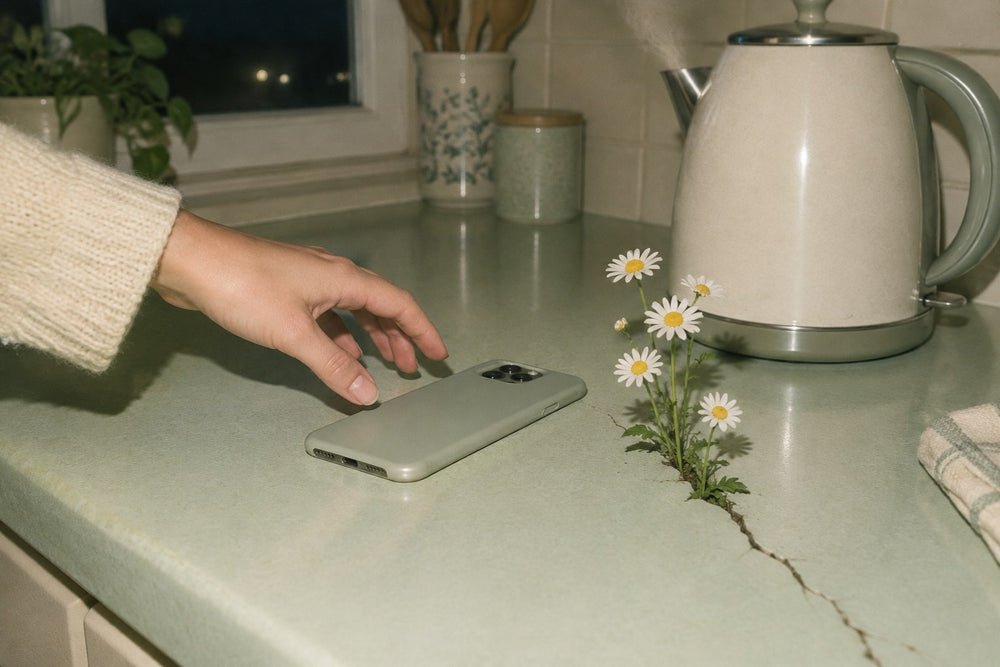
Owen deletes TikTok at 9:20 on a Tuesday. It’s the fourth time since March, but this time he means it. He holds the icon until it wiggles, taps the little minus, confirms. Then he sets the phone face down on the arm of the couch, the way you’d put down a glass you were finished with.
For about four seconds, it feels great.
Then nothing happens.
The dishwasher hums in the kitchen. Somebody upstairs drops something heavy and doesn’t drop anything else. There are forty minutes before he means to go to bed, and nothing in particular he’s supposed to do with them.
He picks up the remote and puts it back down. He flips the phone over to check the weather, which is allowed. Rain on Thursday. He reads one headline. Then, without anything you could call a decision, he’s watching a man restore a rusty pocketknife on YouTube Shorts, which he didn’t delete, and it’s 10:05.
Owen will call this weakness. Most of us would. But the hour he lost to the knife guy is the least interesting part of the evening. Look at the four seconds before it.
What came back
When Owen put the phone down, he didn’t get freedom back. He got the room back.
And the room had things in it. The email from his manager that started with “Quick question” and wasn’t one. The call with his mom on Sunday that went slightly sideways and never got straightened out. The vague feeling that Tuesday had happened to him, rather than the other way around. And under all of it, plain quiet, which turns out to be louder than people expect.
The videos had been sitting on top of all that. That was part of their job.
It isn’t the same job for everyone, or even for the same person every night.
For some people, it’s the bridge between work and sleep, a stretch of road where nothing is required. For some, it’s background noise over a worry that would otherwise take the floor. For someone who lives alone, it can be a room full of voices. For a parent, it can be the first thing all day that doesn’t need a snack.
And sometimes it’s just the easiest feeling within reach: a laugh, a gasp, a dog losing his mind because his owner came home. No choosing required. The next one simply starts.
None of these are silly reasons. They’re why the app keeps getting reinstalled.
The job is still open
There’s a reason the fourth deletion goes like the first three. You can let the employee go, but if nobody reads the job description, the work is still there in the morning. Actually, it’s waiting on the couch at 9:20.
Sometimes the hardest part of giving something up isn’t losing the thing. It’s getting back whatever the thing was holding off.
That’s easy to underestimate, because what comes back usually looks small. Boredom. Silence. A little restlessness. Small isn’t the same as easy, though. In one well-known set of studies, people were left alone in a bare room for about fifteen minutes with nothing to do but think. A surprising number chose to give themselves a mild electric shock rather than just sit there.
Nobody in that room was weak. Having nothing in your hands can feel oddly hard to bear, and most of us will grab whatever is nearby.
Still, most of what shows up in a quiet room isn’t dangerous. Boredom feels like an emergency and almost never is. A flat, slightly sad Tuesday evening is part of an ordinary life, not proof that something has gone wrong.
People get through ten minutes of it the way they get through a waiting room: not enjoying it, not fixing it, just there. It usually passes. Now and then it even turns into something. A thought there hadn’t been room for. The sudden, obvious realization that what you actually wanted was to call your brother.
Not a case against the knife guy
None of this makes the videos the villain. Some nights the job is exactly right. The day was long, your head is wrung out, and twenty minutes of strangers falling off paddleboards is the correct amount of entertainment. That’s not a problem to solve.
The trouble starts when the only question anyone asks is how to stop. Then the only tool anyone reaches for is the delete button. Stopping is an answer. It just answers a question nobody has asked yet: what was this doing for me?
For Owen, on that Tuesday, the honest answer might have been that he didn’t want to think about the email. Or that the apartment was too quiet. Or that he had no idea what to do with forty minutes that belonged only to him. Those are three different problems. None of them get solved by an empty spot on the home screen.
When you put the phone down tonight, what will be sitting on the couch next to you?